
Your farm.
Your deer.
Your ambush.
AmbushIQ reads your trail-cam history, your thermals and the geometry of your ground, then lays out every stand with the reasoning attached — what's working for you, what's against you, and what it isn't sure about. You've walked that ground. The call is yours.
It will flag its own top pick as off its best wind — and leave that to you.
And it started working on that sit back in February.
It learns the ground you actually hunt.
Your stands, your bedding, your deer — not a region.
It's not just the wind.
AmbushIQ fuses everything it knows about your ground into a single score for each stand, each day.
Scent and thermals matter — but they're inputs, not the whole answer. The recommendation is only as good as the full picture, so the app reads all of it, then weighs your deer's own history on top.
↓ All of it, fused into one stand score ↓
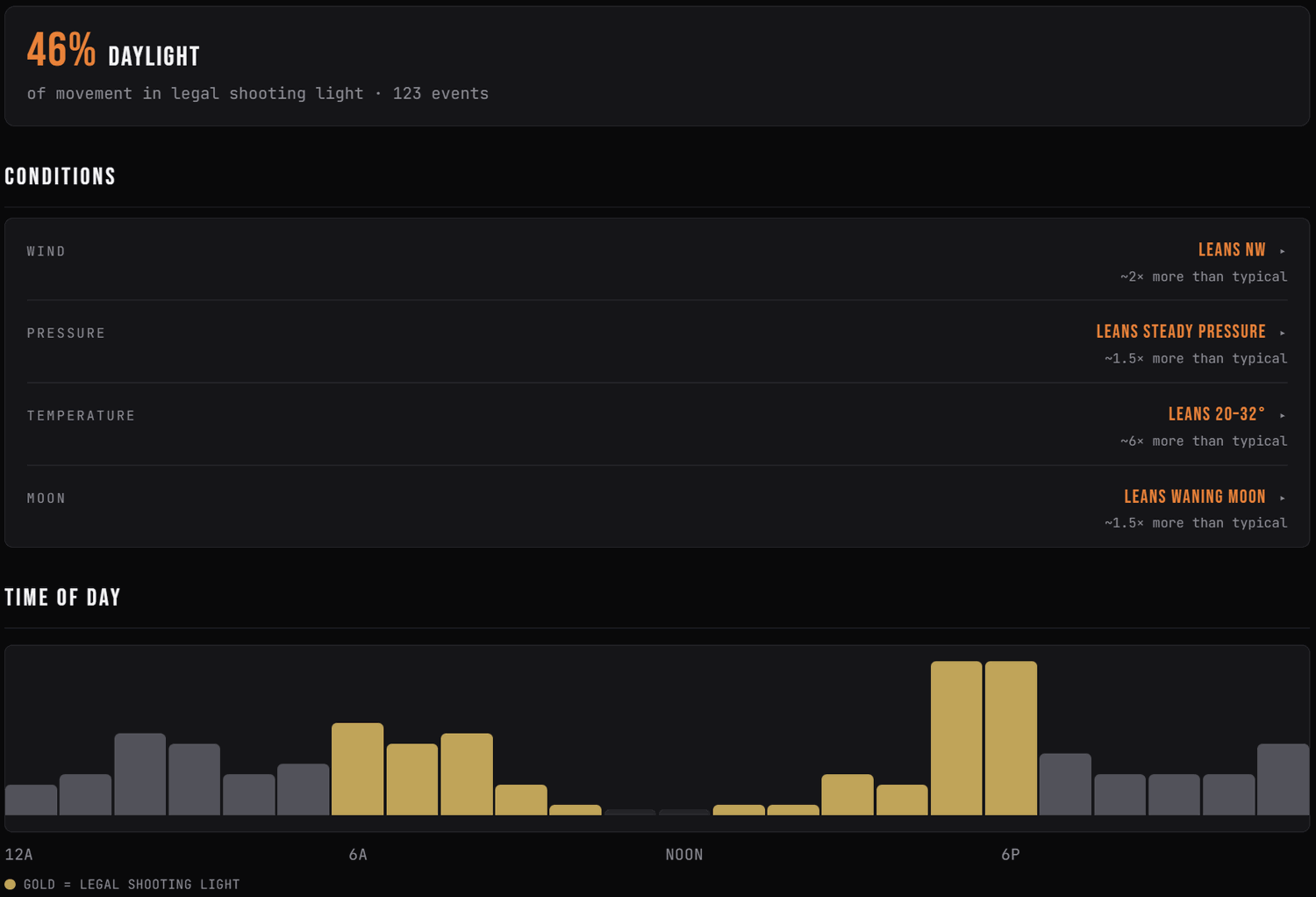 The read behind the score — each condition's lean vs. typical, and movement by the hour
Four months of season. Twelve months of work.
AmbushIQ is with you from the summer habitat work to the blood trail — and every season feeds the next.
Habitat work, counted down to frost
A season-long checklist of habitat tasks — food plots, access, stand prep — anchored to your property's first-frost date, so you do the right work at the right time. The app is useful in July, not just November.
to frost
Your bucks, tracked across every property
Build your target list, tier each buck, and follow them across all the ground you hunt. Every camera photo and sighting sharpens each buck's picture before the season opens.
Every stand scored, every reason shown
Everything the app knows — scent, thermals, geometry, patterns, your logs — worked into a score for every stand, with the reasons in plain sight. Including the ones arguing against its own top pick. And honest when the wind says stay home.
Mark the hit. Read the recovery.
Orient a 3D deer to the exact angle you saw, mark where the arrow or bullet went, and get an honest recovery read — wait times, what to expect on the trail, and the shots that fool you. The part of the hunt that matters most, finally covered.
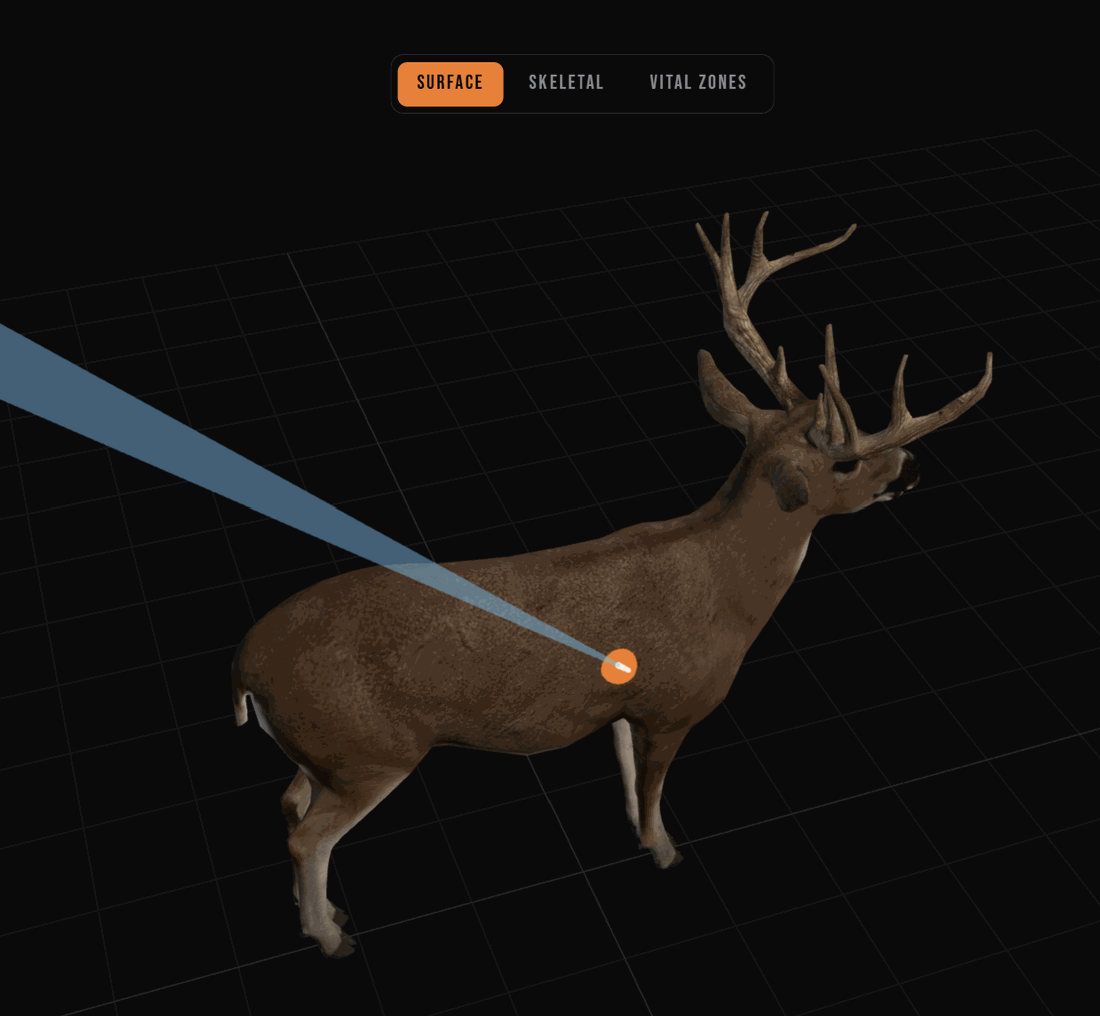 Mark the shot on the 3D model
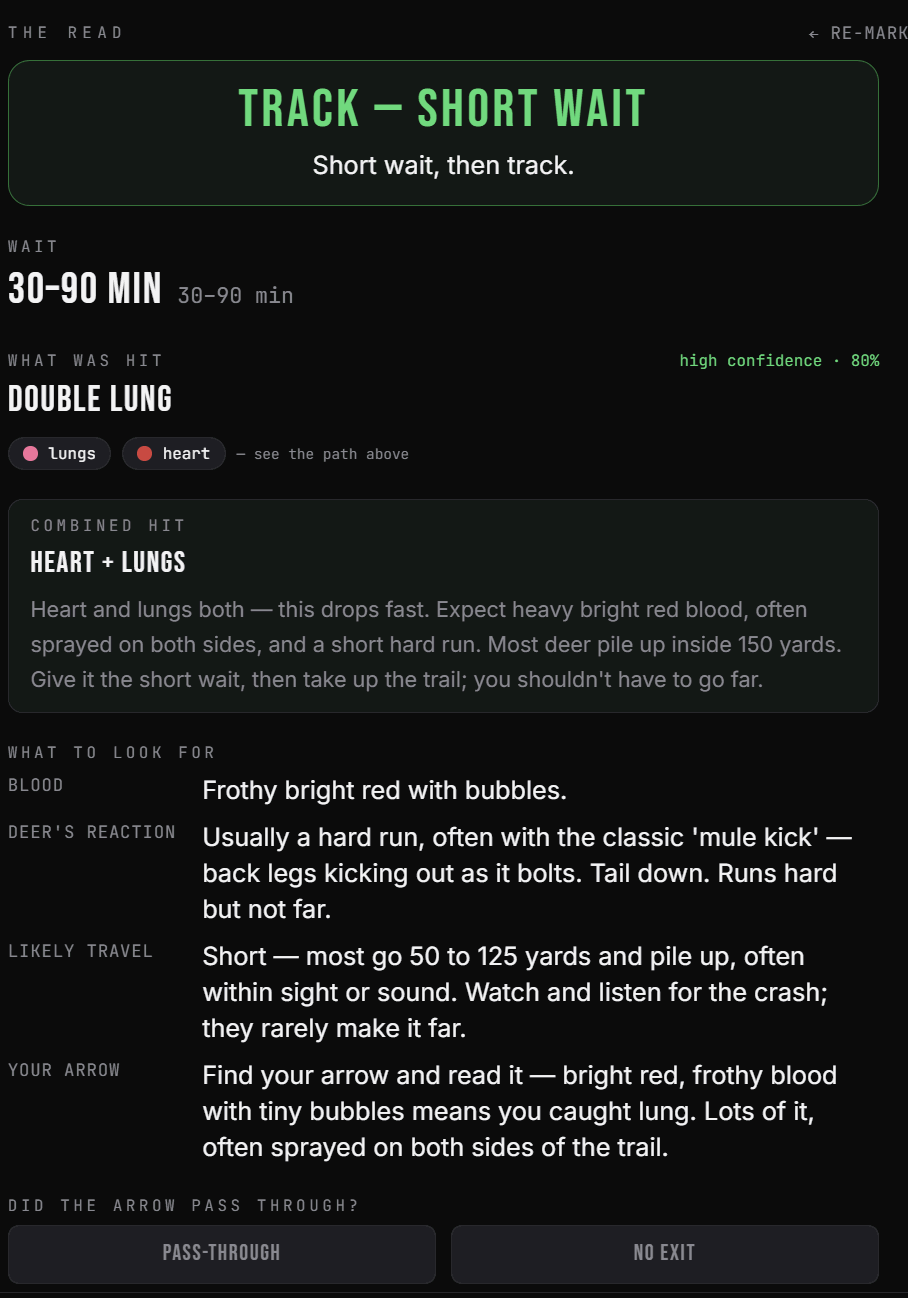 The recovery read — honest, with a confidence
Log every sit — and it grades itself
Record what you saw and what produced. Your log doesn't just sit there: it feeds back into the engine, and the app checks its own calls against what actually happened — and owns it when it missed.
Every sit you log makes next season's calls sharper.Your season, compounding
Your frost date. Not Iowa’s.
Every other habitat calendar hands a hunter in Alabama the same dates it hands one in Minnesota. Plant now. Spray now. Too bad if your first frost is seven weeks later than the guy who wrote it.
AmbushIQ doesn’t run on months. Thirty habitat tasks, each one timed against your property’s own first-frost normals — so the February advice is actually right for your ground.
Port Byron’s first frost: Oct 9Yours is somewhere else, and the whole calendar moves with it
Frost-Seed Window
Broadcast into the freeze–thaw
- Frost seed your clover & chicory
- Thicken a thinning clover plot
- Clear your trails & lanes while the woods are dormant
Late Winter
Sheds, timber, and the after-action
- Shed hunting
- Winter timber work
- Review the season — plan the next
Spring Green-Up
The work that decides October
- Lime & amend from your fall soil test
- Plant a spring/summer crop
- Plant screening cover along your access
- Establish or refresh mineral sites
- Hang & prep stands early
Summer
Maintenance and the long lead
- Mow your clover & chicory
- Pull a soil test for your fall plots
- Add a water hole
- Get your licking branches up
- Summer patterns aren’t fall patterns
Late Summer
The planting window, closing
- Burn down your fall plot ground
- Brassica window — plant now
- Grains — the forgiving plant
- Move cams for the shift
- Don’t plant clover now
Preseason
Last touches, then stay out
- Final stand check — then stay out
- Walk your entry & exit one more time
- Freshen your scrapes
- Don’t burn your best stands early
- Too late to plant — don’t waste the seed
Three of the thirty tasks tell you not to do something. Don’t plant clover now. Don’t burn your best stands early. Too late to plant — don’t waste the seed. And not one of them is allowed to just say no — a negative task has to hand you the thing to do instead: frost seed that clover in February, hunt the fringe and save your best stand for the rut. Every other app in this category only ever adds to your list.
It shows its work.
Two ways to see the season coming at you — a week at a time, and a month at a time. Every number carries the reasons behind it, because a score you can’t argue with is a score you can’t trust.
The app doesn’t decide. It hands you the read and gets out of the way.
The next seven days, ranked and explained
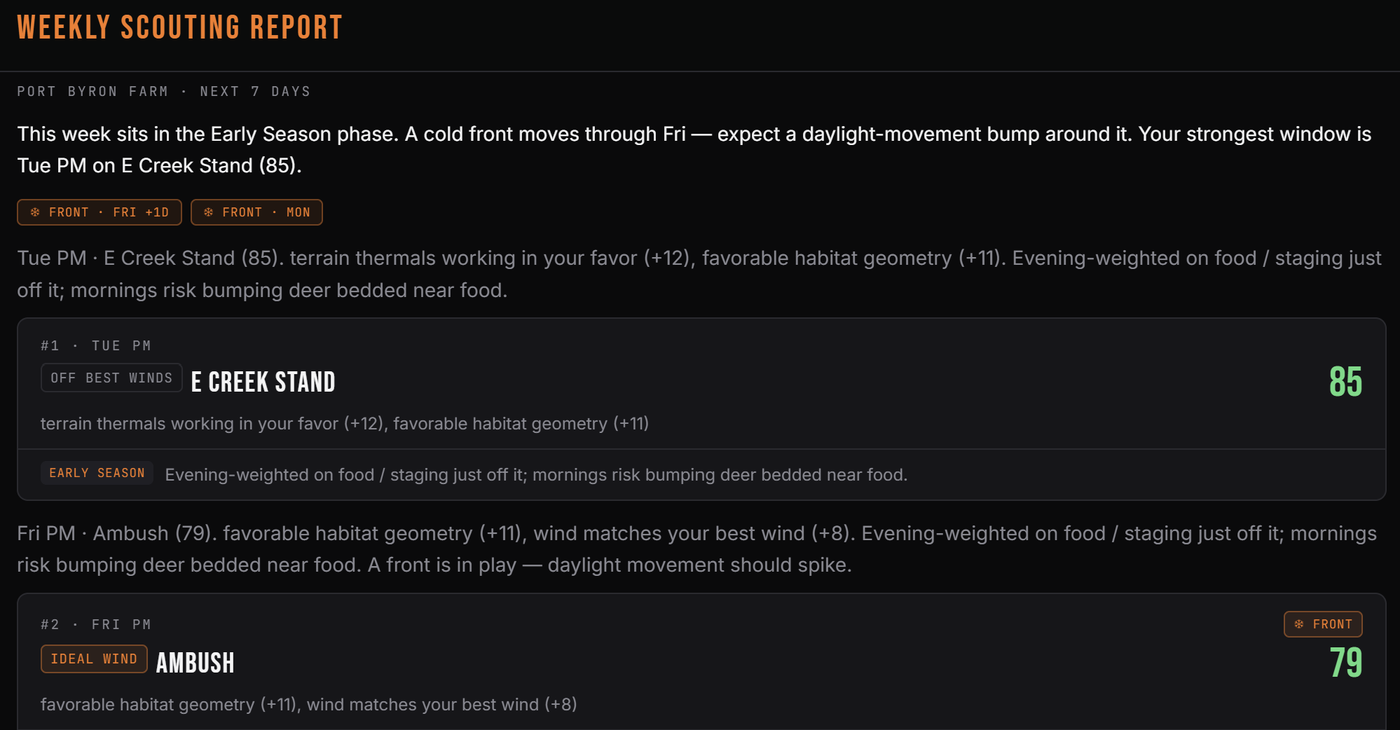
Every stand, every sit, seven days out — ordered by how the conditions stack up. Each one opens into the reasons: thermals, habitat geometry, whether the wind matches the stand’s best wind or fights it. Cold fronts get flagged before they arrive.
It will tell you your top-scoring sit is off its best wind and leave that call to you. A system that only ever agrees with itself isn’t telling you anything.
Which week to burn the vacation days
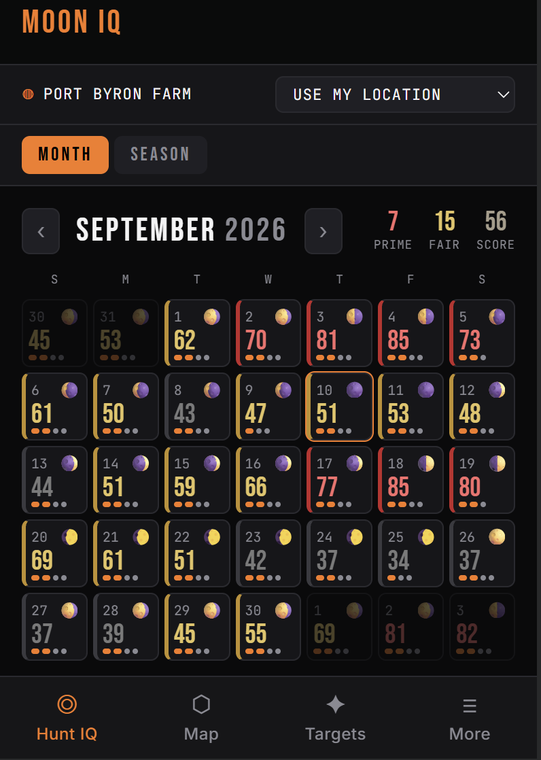
A month or a whole season on one screen — every day scored for your ground, with its moon phase and how much the score can be trusted. September shows seven prime days and fifteen fair ones before you have looked at a single one.
This is the long-range planner, not the day-of call. It is built for the decisions you make weeks out and cannot take back: which week to put in for, when to save your best stand instead of burning it, whether the Saturday you already booked was worth the drive.
Moon phase is one input here, weighted as one input. The research on lunar timing and deer movement is genuinely mixed, and a calendar that promises you a magic day is selling something. Ours tells you how confident it is, day by day, and the answer is often “not very.”
You know your ground. We don’t. AmbushIQ has never walked your property line or watched a doe blow out of that corner three years running. What it can do is hold every variable at once and show you the math — then let the hunter who actually knows the place make the call.
Built for the parts that are actually hard.
AmbushIQ goes past the map and the forecast to the things that decide a hunt: showing you which trees are clean on the wind, learning your deer over seasons, reading the shot when it counts, and being honest enough to tell you when it doesn't know.
It learns the deer on your place
AmbushIQ reads your own cameras and sits to learn how the deer on your ground actually move — the times, the winds, the conditions they key on. Build a hit list and it tracks each buck's own pattern, year over year. Your deer, your ground, your season.
It stays with you past the shot
Orient a 3D deer to your exact angle, mark the hit, and get an honest recovery read — wait times, blood sign, the shots that fool you. When the arrow's gone and your heart's pounding, the app's right there with what to do next.
It tells you when it doesn't know
Thin data gets called thin. A lean gets called a lean, not a lock. And it grades its own calls against what actually happened — and tells you plainly when it was wrong. That's how you trust the calls it does make.
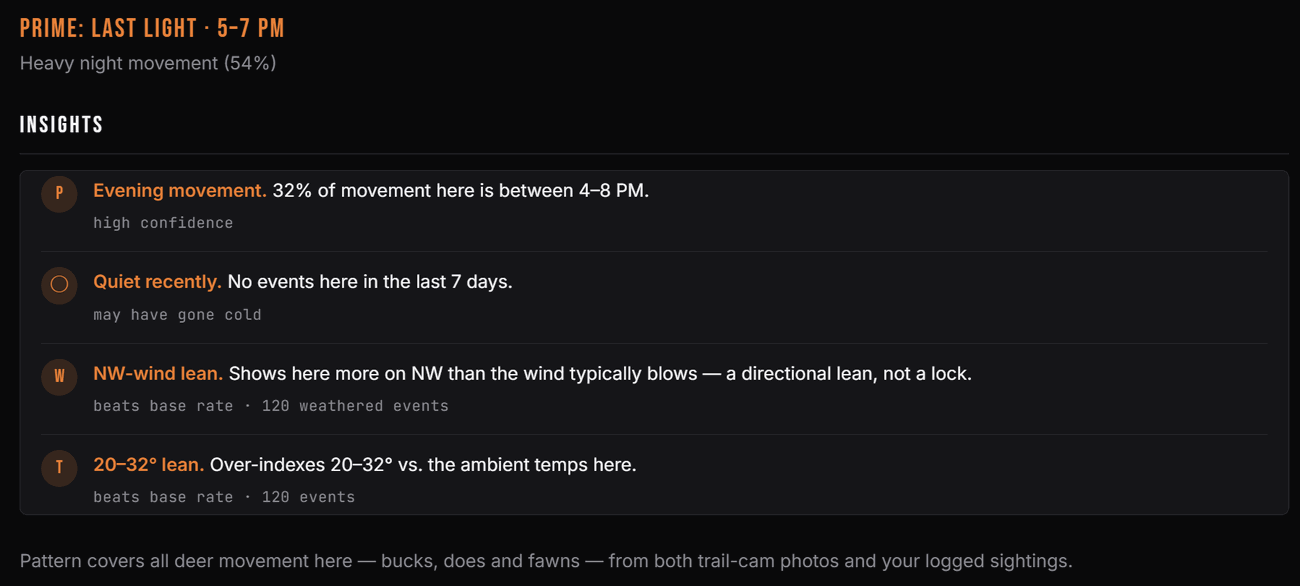 Honest insights — "a lean, not a lock," measured against base rate
It tells you when it doesn't know.
Thin data gets called thin. It grades its own calls — and owns the ones it got wrong.
No focus group. A farm.
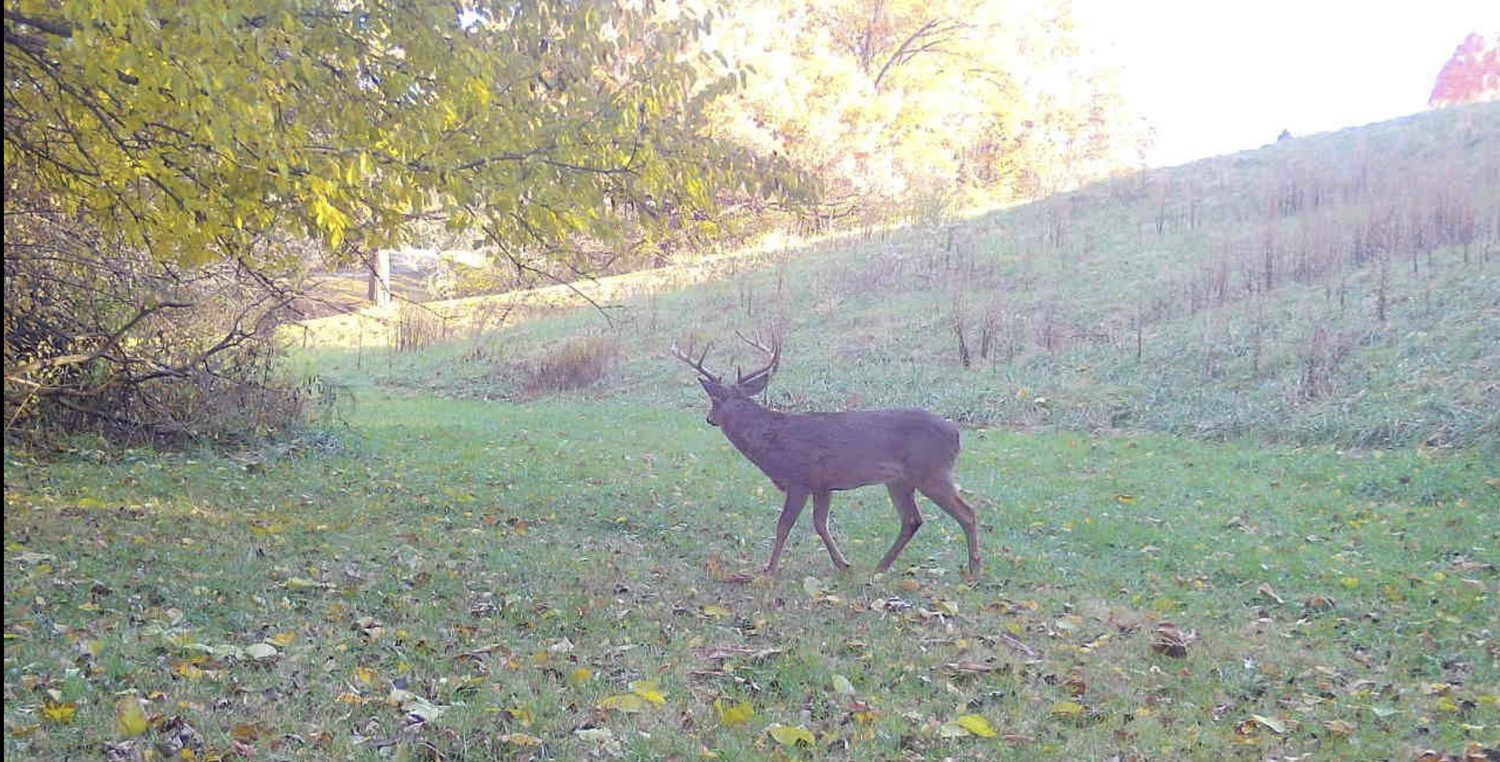
AmbushIQ isn't a dashboard built in an office. It's built by a hunter for the way he actually hunts his own ground — the same cameras, the same stands, the same deer you see on this page. Tex is a real buck. Every screen here is a real read, not a mockup.
That's also why it tells you when it isn't sure. The person who built it would rather hand you the truth than sell you a guess — so when the data's thin, the app says so instead of bluffing a number.
Know what to buy. Buy it once.
Neither of us has money to spend twice, so we research anything we buy to death — reviews, forum threads, hours of video, and the one-star complaints most of all. The Gear IQ pages are that homework written down: every pick scored 1–100 across five pillars, what we cut and why we cut it, and an honest take on the gear we own and run — cons included. A commission never buys a spot.
New to trail cameras? Start with cellular or non-cellular →The type decision costs more than the model decision.
Fixed or mechanical? Start with the broadhead chooser →Two thousand blood trails of recovery data, and the state rules that get hunters cited.
$150 or $6,900? Start with the blind chooser →The tower nobody includes in the price, and the five-year cost of each.
In the works: calls · hunting knives · gloves
Every Gear IQ guide →How we test →Twenty-eight in-depth guides live now — 250 products scored across trail cameras, optics, packs, lighting, archery, blinds, boots, rain gear, scent control and every kind of tree stand.
Affiliate disclosure — Some links here are affiliate links. AmbushIQ is a participant in the Amazon Associates Program — as an Amazon Associate, AmbushIQ earns from qualifying purchases — and buying through them never costs you extra. Placement is set by the Gear IQ score and our own field use — a commission never buys a spot, and gear a brand sends us to test is labeled as such.
More than an app.
AmbushIQ is building the whole system a serious property-hunter needs. Here's what's live, and what's coming.
The App
Stand intelligence, per-buck patterns, and the day-of recommendation. The core of everything.
The Academy
How to read your ground, set cameras, and hunt pressure — the thinking behind the scores.
Video Library
Field breakdowns, setups, and recoveries — the tactics that make the app make sense.
Land Management
Habitat plans with vetted contractor support — turn the ground you hunt into the ground they live on.
Podcast
Conversations on whitetail behavior, property strategy, and the honest side of hunting tech.
The Store
Gear and apparel for the hunter who manages their own ground.
Be first in the timber.
Early access opens ahead of the season. Founding members get in first — and a founding-member rate when it opens. No spam; just the launch, the beta, and new Gear IQ guides as they land.